The story of “wise men from the east” guided by a star to Jesus’s house in Bethlehem that appears in Matthew 2 has mostly confused me. So much mystery—who were these people? The earliest texts all say magi; when William Tyndale rendered this as “wyse men,” subsequent English Bibles through the King James Version lost the Zoroastrian connection of these travelers. European traditions retained the reference to “the Magi,” however, keeping some folk tellings about “Melchior,” “Caspar,” and “Balthazar” within common Nativity scenes and reenactments. But not much beyond some loose association with Zoroastrian priests has ever shown up in most stories about the Nativity, if at all.
We actually have quite a bit of historical source material to approximate what was happening with the group of Magi and why they would show obeisance to Jesus in his infancy. In this case, I think the historical contexts of Zoroastrian religion, Augustan-era Roman-Parthian relations, and Chaldean-Parthian-Greek astrology greatly illuminate (pardon the pun) the presence and actions of the Magi relative to Jesus’s birth.1
These contexts, like so many historically relevant settings, can easily run long before we can grasp how they all bear on a particular event. Hang in there with me—they all tie together, I promise. Let’s start with the political situation leading up to and during the Augustan Era in Roman history.
Rome and Parthia (not Persia)
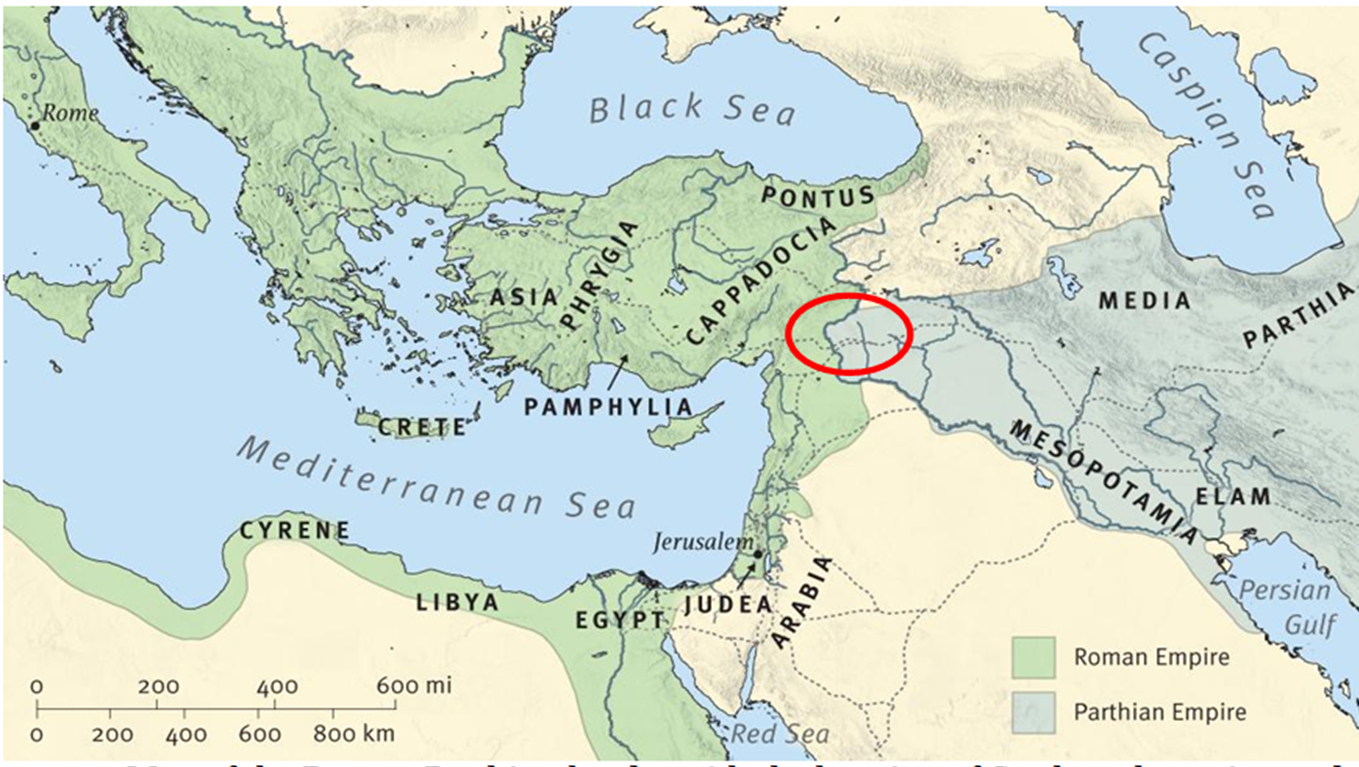
This map shows the Roman Empire (in green) and the Parthian Empire (in blue) during the reign of Julius Caesar. Notice the borderlands within the red circle: these areas were hotly contested by both empires’ armies for over two centuries in what we call the Roman-Parthian Wars. Put simply: Rome wanted simultaneously to expand territory and protect its hold on the Mediterranean Sea; Parthia wanted to expand and protect trade routes across Arabia and lands east as far away as India and China. Neither side, except in a couple of foolhardy campaigns, attempted to outright conquer the other. During these wars, both sides employed diplomatic maneuvering and a great deal of alliance-building with other kingdoms to enhance their “superpower” status.
A Roman general, Crassus, plundered the gold from the Jerusalem temple to finance a campaign against Parthia in 53 BCE, but was terribly defeated—obliterated, really. Along came an Edomite from Idumaea who had converted to Judaism: Antipater, who gained the favor of Julius Caesar and was appointed supreme diplomat over Judaea.2 His son, Herod, was made provincial governor over Galilee in 47 BCE. Seven years later, Parthians smashed Roman troops across Judaea and conquered Jerusalem. Herod traveled to Rome, petitioning the emperor and the senate for armies to reconquer Judaea. The senate appointed Herod as “king of the Ioudaiōn [Judaeans]” and dispatched him to Judaea to win back the territory from a Parthian-sponsored Roman defection of troops and leaders. Herod succeeded in 37 BCE in reconquering Jerusalem and appointed himself king of Judaea. (Romans would regard him as a lesser king, a tetrarch, not an actual royal within the Roman court.)
During the reign of Augustus, Roman diplomatic relations with Parthia improved well enough that both sides retreated from heavy border patrolling. An embassy of Parthian officials, who brought along Zoroastrian Magi (more on this in a minute), made a formal visit to Rome to perform an ancient and solemn act of obeisance referred to in Greek as proskynēsis. This resembled what became a staple of medieval European kingmaking, the coronation: popes or other favored individuals would ceremoniously place the crown upon the head of the new king or queen, thus inaugurating a new reign. Such an act indicated alliance with the new sovereign and carried with it the prestige of having crowned a foreign people’s ruler. The proskynēsis of the Parthian delegation before the Roman emperor Augustus in 19 BCE was commemorated on Roman coins with the image of a Parthian soldier kneeling and putting down his military banners.
The Magi in the entourage functioned as the highest advisors in the Parthian government. Their presence indicated full alliance, much like sending ambassadors and Cabinet secretaries to accompany the Vice President in a U.S. delegation.
By the year 6 BCE, Parthia had cozied up to Rome, but remained certainly interested, perhaps eager, to displace any tetrarch or dynasty near their borders. Such would first come by way of diplomatic maneuvers ahead of combat during the Augustan Era.
Zoroastrian Religion
Magi belong to Mazdayasna, what the West calls Zoroastrianism, an ancient religion that traces its origins to a prophet figure named Zarathushtra (Zoroaster). To understand their behaviors, we have to consider Zarathushtra’s teachings. He announced a revelation from Ahura Mazda, the supreme force of good in the cosmos, that explained how all was created and how, in the primordial age before fixed time began, the malevolent Angra Mainyu opposed Ahura Mazda and their conflict between good and evil had persisted through the present. The purpose of life was to assist Ahura Mazda in the supreme conflict and bring goodness wherever possible.
True goodness, Zarathushtra taught, came by way of good thought, good words, and good deeds. In the cosmology of Mazdayasna, energies are significant: light energies and magnetic energies permeate space and being; by thinking good thoughts, one channels good energies from the stars, planets, sun, moon, and earth into one’s mind; by speaking good words, one channels such energies into the immediate space around oneself; and by doing good deeds, one channels such energies into other entities, thus affecting them toward goodness. Magi priests practiced these all at once, and their patterns of bringing goodness became imagined by medieval Europeans as “magic,” the method of performing incantations or casting spells.
Chaldean-Parthian-Greek Astrology
Within a geographic triangle of ancient Chaldean, Parthian, and Greek cities, many philosophers congregated and shared their astronomical observations. The Zodiac system of astrology was born within this setting. This was a form of divination whereby observers would read the positions of constellations, planets, the sun, and the moon as energy-channel events. Valerius Maximus wrote during the reign of Tiberius that Parthian Magi “teach the motions of the stars, the courses of the planets, the force, individuality, and effect of each one.” The capital of Parthia, Ctesiphon, maintained a symposium of Chaldean, Parthian, and Greek astrologers for decades—precisely surrounding the years of Herod’s reign over Judaea. Magi in Ctesiphon regarded astronomical convergences as particularly significant for imparting natural energies orchestrated by Ahura Mazda for certain people at their birth to come to life bearing Ahura Mazda’s powers or to accomplish a special mission. This tradition of reading constellation signs against other astral phenomena and birth-months has continued into today’s varieties of Zodiacal astrology. The theory was (and is) that reading the signs of the day would indicate back onto each birth-month (or birthday) how Ahura Mazda’s (or nature’s) energies would affect a person.
The Planetary Convergence with Sun and Moon in 6 BCE
Modern astronomy (and ancient sources) confirm that a near-perfect planetary alignment of (at the time) the five known planets with the sun and moon occurred on April 17, 6 BCE. As a Zodiacal event within the Parthian astrological system, this convergence signaled a royal birth, and its position in the sky placed it within the constellation Aries, further indicating the land of Syria. Parthian sources placed the Roman province of Judaea within Syria.
So, at Ctesiphon, it absolutely tracks that Parthian Magi, noting this astronomical event and reading it within their astrological system, would consider this a sign from Ahura Mazda that a royal heir had been born in Syria. Within the politics of the Roman-Parthian Wars and the peace of the Augustan Era, it also tracks that Parthian courtiers would seize the opportunity to identify this heir within Syria and make him obeisance, announcing their alliance with an alternative to Herod’s dynastic line.
Notice, too, how the political situation lends well to the geopolitical maneuver of going right up to Herod as an official delegation of the Parthian court and telling him that an astrological sign has indicated a new king of Judaea had been born within his domain. This could touch off a Herodian outburst—good for Parthia, bad for Rome—or destabilize the political order of Herod, as other courtiers around Herod might vie for power and claim rival status. (Such was super common in the court intrigues of the period and well into the medieval era.) Ah, but Herod is going to keep his cool. He’s not going to be intimidated by such political intrigue. He could strategically use the Parthian delegation to eliminate potential rivals and reinforce his own power relative to the eastern border with Parthia.
Magi and Jesus
We come to the account in Matthew 2. We know it well enough—except now, we have context that can flesh it out a bit more. It says Magi from the east came to Jerusalem, probably as part of an entourage of Parthian ambassadors, and met with Herod saying “Where is the one who has been born king of the Ioudaiōn [Judaeans]? For we have seen his star at its rising and have come to proskynēsai [before] him.” Herod, it says, was troubled by this news, “and all Jerusalem with him,” an ancient way of saying the Jerusalem court was also confronted with political trouble. The account implies a delay, especially if we remember the political context: this is an official visit by state actors from Parthia that include Magi in their entourage, and so their reply to the Parthians would carry foreign-relations weight. After bringing together his advisors—the chief priests and scribes—Herod inquires into the traditional rival he already knows about: the prophesied Mashiach, the one anointed by God to reclaim the throne of David and restore the glory of Jerusalem. The advisors consult their prophetic texts (which don’t yet exist as a biblia or canon, but rather as individual loose scrolls), and find Micah predicting such a ruler would be born in the city of David, Bethlehem.
Matthew notes this oddity: “Then Herod secretly summoned the Magi and determined precisely from them the time when the star appeared.” Within the context of there likely being a Parthian delegation, the “secretly” summoning the Magi from the rest of the group specifically to learn the timing of the astrological event, this makes sense. Herod’s intrigue involves both the Jewish prophecy of Mashiach/Messiah and the Zoroastrian advisors’ astrological claim that such an event could have been signaled, at least to his Parthian rivals. He’s in the middle of determining his strategy and his maneuver. Learning from the Magi about an astrological reading gives him confidence in making this play: let the delegation follow the convergence-against-Aries sign toward Bethlehem; let them even make obeisance to this rival heir; and then feign the intention to also acknowledge this newborn as his own heir. He could accomplish two objectives: placate the Parthians, then remove the rival heir and consolidate his power within his own dynastic line. It’s a smart political strategy when you’re trying to frustrate your foreign neighbors and appeal to your Roman overlords at the same time.
Matthew’s reference to the Magi tracking the star all the way to Jesus’s house in Bethlehem—it “led them until it came and stood above the place where the child was”—makes sense within Zoroastrian astral-energy readings. It’s not like the star (probably Jupiter, which in this astronomical convergence glowed brightest of the planets and did, in fact, “move” within parallax differently than the others) physically moved with their own walking. Zoroastrian sources in the Gathas and elsewhere depict astral energies radiating from stars in a kind of aura. It’s probably this kind of astrological reading that Matthew assumes the Magi made to reach Jesus’s house.
The Magi arrive at the house, see Jesus with Mary, and pesontes (=knelt down) and prosekynēsan (made proskynēsis-style obeisance) before Jesus. They then offer Jesus gold, frankincense, and myrrh—each element used in several Parthian embassy pledges made only in coronation-esque ceremonies that officially recognized a foreign ruler. They ditch Herod, heading back to Parthia by another route than they had come, leading to Herod’s fury that he had been thwarted and the subsequent massacre of male Judaean toddlers and infants in and around Bethlehem.
Takeaways
Some observers reach to the Saoshyant figure prophesied about in Zoroastrian scripture that predates the Old Testament—a “savior” that Ahura Mazda promised to send and inaugurate a Mazdean kingdom on the earth. They figure this must have motivated the Magi to trek westward to find Jesus. The problem with this interpretation, however, is that it perpetuates a later Christian notion of messianic prophecy and some anachronisms. Scholars haven’t found Near Eastern Magi during the Augustan Era who were documented to have spoken of the Saoshyant, to say nothing of seeking him out. Still, silence doesn’t imply non-existence. I just think the odds lean more strongly toward the facts we can establish, and the Parthian context matches the Matthew narrative and many other sources much better.
In noticing how Jesus had scarcely been alive before political interests converged around him, we can notice, as well, just what a radical figure he was when he relinquished imperial and political claim. We can see why fleeing to Egypt was necessary: heading into Parthia would play into the political intrigue and further jeopardize Jesus’s safety. We can see the mockery in the Tempter’s words to Jesus in the wilderness, also recorded in Matthew, when he promised Jesus the kingdoms of the world “and their glory … if you will pesōn and proskynēsēs me,” literally what a kingdom’s delegation did before the infant Jesus. We can see Jesus’s context for insisting that proskynēsis be performed before God alone. Such takeaways enhance, at least for me, a story of the Nativity well beyond a supposed devotional worship by mysterious travelers randomly tracking a star in the sky. It also helps to explain why such devoted worshipers, upon finding the Messiah, suddenly … bolted? If the Magi functioned as political advisors rather than mystical seekers of the Saoshyant, their immediate return to the east appears more realistic.
My sources for this contextualization include: Antonio Panaino, “Cosmologies and Astrology,” chap. 14 in The Wiley Blackwell Companion to Zoroastrianism, edited by Michael Stausberg and Yuhan Sohrab-Dinshaw Vevaina, updated ed. (Malden, MA: John Wiley and Sons, 2022), 235–257; Marco Frenschkowski, “Christianity,” chap. 29 in Stausberg and Sohrab-Dinshaw Vevaina, eds., Companion to Zoroastrianism, 457–475; George H. van Kooten and Peter Barhel, eds., The Star of Bethlehem and the Magi: Interdisciplinary Perspectives from Experts on the Ancient Near East, the Greco-Roman World, and Modern Astronomy (Leiden: Brill, 2015), especially van Kooten’s chapter in this volume, “Matthew, the Parthians, and the Magi: A Contextualization of Matthew’s Gospel in Roman-Parthian Relations of the First Centuries BCE and CE,” 496–646. ↩
Perhaps interestingly, this means Herod had Arab ethnicity and non-Israelite ancestry that traced back to Esau, the patriarchal figure of the Edomites; so Herod and the Jewish people throughout Judaea would have appeared phenotypically dissimilar and had a different relationship to Jewish law, which is evident in how Herod behaves relative to the chief priests in Jerusalem. Another topic for another day, though. ↩